Water is part of nearly every routine at home. We use it to make coffee in the morning, wash dishes after dinner, take a shower before work, and keep clothes fresh throughout the week. Because it’s so familiar, we don’t always notice its quality until something feels off. Maybe the water leaves white marks on the faucet, the drinking water tastes unpleasant, or the shower seems to leave soap residue behind.
These issues can have different causes, and the right solution depends on what’s actually in your water. A well-planned treatment setup can improve everyday convenience, help manage mineral deposits, and provide more confidence in the water you use. The key is choosing equipment based on your household’s needs rather than assuming one product can fix everything.
Understanding Your Home’s Water Supply
Before buying treatment equipment, take a closer look at your water source. Homes supplied by municipal water systems generally receive treated water, but mineral content, taste, and plumbing conditions can still vary. Properties using private wells have additional considerations because groundwater quality can change with rainfall, nearby land use, and local geological conditions.
A simple water hardness test can help identify whether calcium and magnesium are contributing to scale around taps, showerheads, and appliances. If your concern involves an unusual odor, discoloration, or possible contamination, more specific testing may be needed.
This is where residential water treatment becomes a practical, rather than purely technical, consideration. It involves selecting suitable methods for the water entering your home and the way your family uses it. Some households need help with hard water, while others may benefit from sediment filtration or a drinking-water filter designed for particular contaminants.
Start with the problem you want to solve. That small step can save you from purchasing equipment that looks impressive but doesn’t address the issue.
When Hard Water Becomes a Daily Frustration
Hard water contains dissolved minerals, mainly calcium and magnesium. These minerals aren’t usually a sign that the water is unsafe, but they can make certain household tasks more difficult.
You may notice white deposits on faucets, cloudy glassware, or a chalky layer inside your kettle. Soap can also behave differently in hard water, and mineral buildup may collect inside water heaters and other appliances that use hot water.
Over time, significant scale can contribute to maintenance problems or affect heat transfer in some equipment. The actual impact depends on water chemistry, temperature, usage, and appliance design. Not every appliance issue is caused by hardness, but persistent deposits are worth investigating.
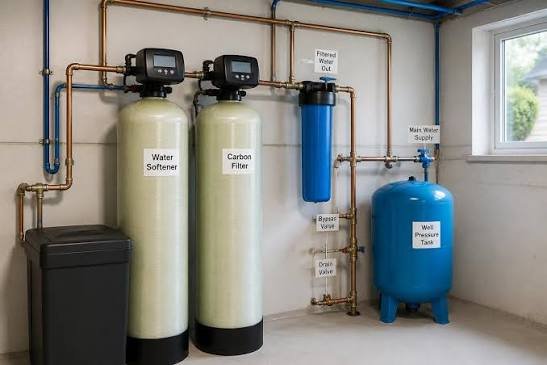
A conventional water softener can help when hardness is the main concern. These systems typically use ion exchange to reduce calcium and magnesium in the treated water. The result may be less scale formation, easier cleaning, and improved soap performance.
However, a softener isn’t a universal filter. It doesn’t automatically remove bacteria, every chemical contaminant, or all substances that affect taste and odor. Those concerns need their own assessment and, when necessary, a separate treatment method.
How Water Softeners Can Help
For homes with moderately or very hard water, water softeners can make a noticeable difference in daily maintenance. By reducing hardness minerals, they can help limit the deposits that accumulate on fixtures, in pipes, and on surfaces exposed to water.
Many conventional softeners contain resin beads that exchange calcium and magnesium ions for sodium or potassium ions. When the resin becomes saturated, the system regenerates it using a suitable regenerant, commonly salt. The process restores the resin so it can continue softening water.
There are a few things to consider before installing one. The system must be sized for your household’s water consumption and hardness level. It also needs appropriate plumbing connections and, in most cases, access to a drain for regeneration.
Operating costs matter, too. Salt, water used during regeneration, maintenance, and eventual replacement parts should all be included in your budget. If sodium intake is a medical concern, speak with a healthcare professional about your drinking-water options. A separate drinking-water supply may be appropriate in some homes.
The best system isn’t necessarily the largest one available. It’s the one that meets your needs without creating unnecessary expense or maintenance.
Improving Drinking Water at the Kitchen Tap
Water used for drinking and cooking deserves its own consideration. Some people dislike the taste or smell of their tap water, while others want to reduce specific dissolved substances identified through testing. The right treatment depends on the source water and the intended outcome.
Carbon filtration can improve certain taste and odor issues, depending on the filter’s design and certification. Other filtration technologies are intended for particular contaminants. It’s important to check the manufacturer’s documented performance rather than assuming that every filter removes the same substances.
For households looking for more advanced treatment at a dedicated drinking-water tap, reverse osmosis drinking water systems may be worth considering. These systems push water through a semipermeable membrane that reduces many dissolved substances. Depending on the model and configuration, additional filters may be used to improve taste or protect the membrane.
Reverse osmosis isn’t automatically necessary for every home. The equipment can require periodic filter and membrane replacement, and many systems send some water to a drain during operation. Performance also depends on incoming water conditions and correct maintenance.
Before buying, identify which substances you want to reduce and check that the selected system has been tested for those specific claims. If your water is already suitable for drinking and your only complaint is mild taste, a simpler option might be enough.
Whole-Home Treatment or Point-of-Use Filtration?
One of the most important decisions is where the water should be treated. Whole-home equipment is installed where water enters the property, allowing it to treat the supply to multiple fixtures. This can be useful when the problem affects showers, laundry, appliances, and other parts of the house.
Point-of-use equipment, by comparison, treats water at a specific location, such as the kitchen sink. It’s often a sensible option when the main goal is improving drinking or cooking water rather than treating every tap.
Some households benefit from a combination of technologies, but more equipment doesn’t always mean better results. Additional systems can increase installation costs, maintenance requirements, and the number of components that need attention.
A qualified water treatment professional can help compare the options based on test results, household size, plumbing layout, and budget. Ask for a clear explanation of what each component is designed to do.
Installation and Maintenance Shouldn’t Be Afterthoughts
Even a well-chosen system needs proper installation. Equipment must be compatible with the water supply, have enough capacity for peak demand, and be installed according to the manufacturer’s instructions. Poor sizing or incorrect connections can lead to disappointing performance.
Once the system is operating, follow the recommended service schedule. Replace cartridges when required, replenish softener salt if applicable, and check for leaks or unexpected changes in water pressure. Keep records of maintenance dates so you know when attention is due.
If water quality changes suddenly, don’t assume the treatment system will correct it automatically. Arrange appropriate testing or inspection to identify the cause. This is especially important for private wells, where periodic testing can help identify changes that aren’t visible or detectable by taste alone.
Make a Choice That Fits Your Household
Better water doesn’t always require a complicated setup. Sometimes a simple filter addresses the main concern; in other cases, a softener or a more specialized treatment system is appropriate. What matters is matching the solution to the water conditions and your everyday priorities.
Begin with reliable testing, compare equipment based on its proven capabilities, and account for maintenance as well as installation costs. Be cautious of products that promise to solve every possible water problem with one device.
Water should support your daily routine, not create another chore. With a clear understanding of your supply and a treatment system chosen for the right reasons, you can make household maintenance easier and enjoy greater confidence in the water you use every day.

Admin
A contributor to Blognary’s independent wall of business, technology, finance and marketing perspectives.
VIEW ALL ARTICLES